
When It's Not Just “Getting Older”: The Signs and Symptoms of Spinal Cord Compression
Written by Dr. Thomas Jones
Many people chalk up aches, stiffness, and slowing down to the natural process of aging. But sometimes, these symptoms are a signal of something more serious — a condition called cervical myelopathy, or compression of the spinal cord in the neck. Knowing the difference could protect your long-term health and independence.
What Is Cervical Myelopathy?
The spinal cord runs through a protective bony canal in your spine. As we age, the discs and joints of the neck can degenerate, thicken, or shift — gradually squeezing the spinal cord. Unlike a pinched nerve, which typically causes pain in one area, spinal cord compression can disrupt the nerve signals that control movement and sensation throughout your entire body below the neck. Oftentimes there is no pain despite these degenerative changes.
The Warning Signs
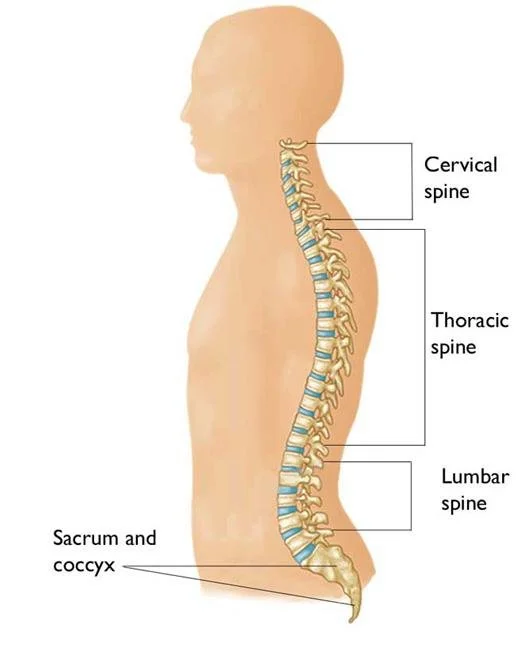
Your spine is made up of 24 bones, called vertebrae, that are stacked on top of one another.
The seven small vertebrae that begin at the base of the skull and form the neck make up the cervical spine.
Image courtesy of the American Academy of Orthopaedic Surgeons
Weakness is often one of the earliest clues. You may notice difficulty opening jars, gripping a steering wheel, or carrying groceries. Leg weakness can make climbing stairs feel unexpectedly strenuous. This isn't ordinary fatigue — it's your muscles receiving weaker signals from a compromised spinal cord.
Motor incoordination is another hallmark. Fine motor tasks — buttoning a shirt, writing, or typing — may become frustratingly clumsy. Hands that once moved with ease can feel awkward and unreliable. Many patients describe it as feeling like their hands "just don't cooperate" the way they used to.
Gait instability is perhaps the most dangerous symptom. Walking may feel unsteady, as though the ground is shifting beneath you. You might notice a wide, shuffling stride or a tendency to stumble. Falls become a real risk, and many people unconsciously begin holding walls or railings they never needed before.
Changes in sensation round out the picture. Numbness, tingling, or a shock-like sensation that shoots down the spine when you bend your neck (known as Lhermitte's sign) are red flags. Some people describe a persistent "heavy" or "electric" feeling in their arms or legs.
When to Seek Help
If you recognize any combination of these symptoms — especially progressive weakness, coordination problems, or unsteady walking — don't dismiss them as normal aging. Cervical myelopathy tends to worsen over time, and early treatment leads to significantly better outcomes. A visit to your doctor, followed by an MRI of the cervical spine, can provide answers. In many cases, surgical decompression can halt progression and restore function.
The good news is that cervical myelopathy is treatable, particularly when it is identified early. If you are experiencing worsening weakness, difficulty with coordination, balance issues, or numbness, talk with your physician. An evaluation can help determine whether your symptoms are part of the aging process or a sign of something that deserves prompt attention.
Trust your instincts. If something feels off beyond ordinary getting older, it very well may be.

Dr. Thomas Jones
Orthopaedic Surgeon
MD, FAAOS
Dr. Jones is a fellowship-trained, board-certified orthopedic spine surgeon specializing in the surgical and nonsurgical treatment of back, neck, and spine conditions, including disc disease, arthritis, spinal fractures, and scoliosis.
He provides personalized spine care focused on identifying the true source of pain and developing individualized treatment plans that help patients restore function, reduce symptoms, and improve their quality of life.
View full profile →